|
Note! These are just a snippet of the 7Hex Dragon House Rules that are
referenced frequently in this web site making for easier
reference..
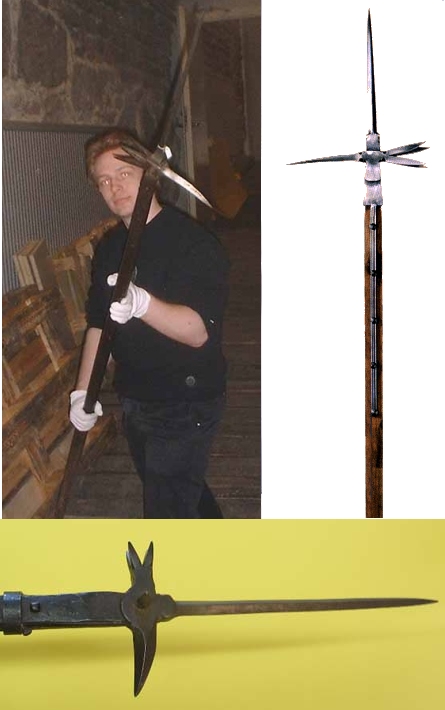
- Pick/Hammer IQ 8 Talent (2)
A weapon talent more amenable to the hammer lover. The Hammer/Pick
talent lets you use a good range of weapons without having to have
multiple talents to get them. The sword people get the dagger (which
everyone has to have to survive HTH), really good one handed weapons
like the bastard sword and the highest damage weapon Great Sword. So
they can have a dagger (which doubles as a buckler via Main-Gauche) at
their belt, a bastard sword and a backup Great Sword all for 2 talent
points. Everyone else has to pick up knife for one and then if they go
with PoleArm, there are no good one handed weapons (the spear does a
whopping 1+1) so many pick up sword to get the dagger and good backup
weapon. Even the Axe/Hammer/Mace people have to pick up an extra 1 for
knife and maybe 1 for shield. So we have the Hammer/Pick talent which
trains in:
Hammer
Military Pick
Great
Hammer
Pole Hammer
(Bec-de-Corbin)
Heavy Pole Hammer (Lucern
Hammer)
Now we still need the knife talent, but at least we
have a good backup weapon if our Bec-de-Corbin breaks (the Military
Pick!), or a good two handed backup if our millitary pick
breaks.
- Weapon Mastery IQ 10 Talent
(3)
Prerequisite - Relevant Weapon/Shield Talent. This replaces
the Fencing Talent for any non-missile/non-thrown weapon (but note you
can have mastery with an Axe, you just don't get any Mastery
advantages if you throw it). The lower of DX or AdjDX with the
mastered weapon must be 13 (i.e. an unarmoured swordsman with DX 12
and a +1DX Fine Broadsword is not eligible to be a Master at all and a
DX 14 Swordsman in Chainmail can have the talent, but will get no
benefit until he gets his AdjDX up to 13). If the lower of DX and
AdjDX is 13, 14, or 15 he does +2 Damage with the weapon. Also,
attackers are at -2DX to hit you when you are using your Mastered
weapon and they are in your front hexes. Finally, attempts to engage
in HTH combat from a Master's front hexes while using the Mastered
Weapon rolls at +1 for HTH results (i.e. resulting in less likely that
the HTH will occur). If the lower DX and AdjDX with the Mastered
Weapon is 16 or higher, he gets +3 Damage, opponents are at -3DX to
hit, and the Master adds 2 to HTH outcome rolls for attempts to engage
in the Master's front hexes while wielding the Mastered Weapon. This
seems to reflect what I have seen of advanced swordsmen, they are
better attackers (being more accurate and using leverage not strength
for smoother, flowing attacks) and better defenders (knowing and
keeping the right distance, using the weapon to keep the opponent
away, etc) making them harder to hit.
One of the deficits of TFT was the high DX fighter one-shot
kill. We have tried to curb that with slowing character advancement
past 50 points and adding better defense possibilities with
Weapon/Shield Master (so even the 15AdjDX fighter would be reduced to
12AdjDX facing a Weapon Master and 10AdjDX facing a Weapon/Shield
Master).
Note: I have generally only applied this to one weapon and not a
weapon type (i.e. not all swords or all axes/maces/hammers, etc like
the basic talents). Rather you are Master of 1Handed Axe, or 1 Handed
Hammer/Pick, or 2H Sword, etc. I do tend to allow very close
weapons to count like: Broadsword and Bastard Sword (used one handed
only), Halberd and PikeAx (but not spear or naginata), Javelin and 1
Handed Spear (but not 2 handed spear), etc.
- Shield Mastery: IQ 10 Talent (3)
Prerequisite - Shield talent and the lower of DX or AdjDX must be
12. Similar to Weapon Mastery (and same IQ level as Fencing), but
gives the user +2 hits stopped and -2DX to an opponent to hit you when
you have a Shield ready and your attacker is in one of your front
hexes. Additionally, "spiked shield rushes" do +2 damage. This can be
combined with weapon mastery for a potent combo of -4 or -5DX and an
extra 2 hits stopped, but note the 3 IQ cost for both (plus the weapon
talent, shield talent would take up 9 IQ points and the high DX
requirement would limit armour in all but the highest point
super-characters). The Shield Master does not get the HTH bonus (the
idea is that the attempt to engage in HTH is met with the business end
of a deadly weapon).
- Pole Arms
Please see the full 7Hex Dragon
House Rules for damage tables and a fuller discussion. We have
some real PoleArm addicts so we reworked the PoleArm section to better
balace them (we take away some of the high level charge damage but add
a just a little back with 2 new pole arms).
First a new PoleArm that does just a little more damage than the
Halberd and PikeAx, the PoleHammer. This is a PoleArm of the
Bec-de-Corbin type, see
damage table above. If you want to integrate it into the classic TFT,
then it will do 2d like the halberd and weigh the same and be 2 meters
long, but will ignore up to 2hits of armour. It was made with both a
fluke/spike designed to puncture thin armour and a four pronged hammer
designed to heavily percuss and even significantly damage thicker
armour (and a long spike on top to take a charge). These kinds of
weapons start to take over the sword in duels after the advent of
Plate Armour (with the recognition that the PoleHammer will do more
damage to a man in PlateArmour than a sword, but a little less than
against an unarmoured man). Minimum ST is 14. Shields do not
count as armour and are still effective in blocking hits, but
hides/scales/fur/StoneSkin, etc do count as armour. Examples: a
Gargoyle attacked with a PoleHammer will only have 1 effective hit
armour. A man with cloth armour and a small shield will still block 1
point of damage for the shield, but the cloth armour is negated by the
PoleHammer. A bear would have no effective armour against a
PoleHammer. You can also have a Heavy PoleHammer, like the Lucern
Hammer, that does the same 2+2 damage as the PikeAx, but ignores up to
3 hits of armour and minimum ST of 16 to wield it. It has the same
weight and length as the PikeAx. If you are using
7Hex Dragon House Rules, the
damages for the PoleHammer and Heavy PoleHammer are given in the
weapons table there.
Now that we have given the PoleArm user some new toys, we take away
some of the insane Charge Attack damage. If you are using the
7HexDragon damages for weapons (see below, or the full
House Rules), then you do double the
weapon portion of damage (not the total damage, the ST modifier is not
doubled), but that is much less (the PoleHammer only does 1+1 and the
Heavy PoleHammer only does 1+2, plus non-doubled ST modifier). For
example, a 16ST Hero wielding a HeavyPolehammer charge attacks a
wolf. Since it is a Heavy PoleHammer it ignores the armour of the wolf
(note the Heavy PoleHammer actually ignores up to 3 hits armour, but
does not get any further bonus after ignoring the wolf's 1 hit armour:
i.e. the PoleHammer does not get to do an additional 2 points of
damage since the wolf only had 1 hit armour). The Base Unarmed Damage
for a 16ST Hero is 1d, the Heavy PoleHammer does 1+2, doubled for
charge, 2+4. Total charge damage is 3+4 and ignores the wolf's 1 point
fur. In to alter Classic TFT to cut back the charge damage: Heavy
PoleArms (Halberd, PoleHammer, PikeAx) do an extra 1.5xdamage
(basically 3D and 3D+4), not double. Light PoleArms (Javelin,
Naginata, Spear) do an extra 1d damage in a Charge Attack
situation. This is much less damage for the heavy ones (halberd
averages 10hits vs 14 in cannonical TFT, Pike Axe does 14 as opposed
to 18 in cannonical TFT which we deem reasonable for all the handicaps
that pole arms bring to the table), but we tried to compensate a bit
with the PoleHammer and the Mastery Talent above. Reducing armour
gives some controlled damage back without the huge potential of doing
4+4 (28 hits or more if it is Fine or Enchanted!). We would also like
to note that the idea of a recipient of a charge attack attacking the
halberd of the attacker and chop it in half is patently ridiculous
both in terms of basic physics (a war spear is a hefty round of
treated hard wood and most halberd/bec-de-corbin/etc had steel
languets down the side, there is no way a sword or axe can come
anywhere close to cutting through that by hitting it in mid-air) and,
in terms of balance, renders the pole arm utterly useless (no on in their
right mind would take a two handed weapon that only does 2D and does
not allow you to have a good 1 handed backup weapon and will likely be
useless in any give combat situation).
HTH vs. PoleArms: If a charging attacker is successfully hit by a
polearm user for extra damage due to being set to take a charge
attack, the charging character cannot initiate HTH combat that turn
(i.e. he has been impaled at a distance of 3-5 feet away and can only
swing a weapon on his turn). He is stopped in the adjacent hex. Next
turn charging attacker may attempt HTH. Additionally flying creatures
dropping down into HTH are considered to be charge attacking and can
be impaled. If they are hit for extra damage they fall into a random
hex (roll 1d6) next to the PoleArm wielder and must save 3DvsDX to
avoid falling down into that hex. They may attack if they do not fall
down, but not initiate HTH.
- New Armour
We have added
Bringandine/Scale armour consisting of a lightly treated layer of
leather with scales or thin plates riveted under the treated leather,
then soft Leather under that. The plates were very effective against
blades and the triple layers spread the impact of blunt weapons around
a bit. Stops 4 hits and is -4 DX.
We allow Fine Chainmail and Fine Brigandine/Scale to take the same
number of hits, but take one less point off of DX (-2 for Chainmail
and -3 for Scale/Bringandine). The cost is 10x that of regular
Chain/Brigandine (it can be made with lighter materials and overall
better workmanship to reduce weight and to form fit the user), it has
to be custom made for the user like Fine Plate and can't be "found".
- Spirit Magic
There are two kinds of magic, normal/mana and spirit. Spirit Magic
uses the Spirit Field. The Spirit Field is distantly analogous to the
Gravity Field. Live individual spirits carry with them a weak Field
that attracts other spirits and Spirit Energy, the stronger the Spirit
the stronger the Field. Spirit Energy is the imprints and remnants of
significant spiritual events (death, strong emotion, high creativity,
etc) and the vague spirit life of plants and animals that floats about
us, unrecognized. Normal magic and spirit magic have some similar
characteristics and are not entirely disjunct, but learning one does
put you at a disadvange for learning the most different parts of the
other. So Necromancers, who use Spirit Magic, can learn elemental
spells like Lighting at a cost of 3IQ points per spell, and a regular
wizard can learn purely Necromantic spells such as Spirit Jar at a
cost of 3IQ points. Spirit Magic is adept at affecting living
organisms (see Decrepitude, Induce Fear), manipulating and binding the
Spirit Field (see Spirit Jar, Golem or Become Lich) or recalling
spirits to do your bidding (see Spectre, Summon Skeleton Lord). Spirit
Magic is un-adept at manipulating non-living matter (Lightning, Open
Tunnel, Drop Weapon, Rope, non-Demon/non-undead summoning spells).
Other properties of the Field is that it flows around the Necromancer
and he can "focus" it on certain objects in different ways. This
limits the number of kinds of Spirit things he can have at once. The
Spirit Jar creates a flow focus that is disrupted if another Spirit
Jar is added to the Necromancer's Field. Similarly with the Golem.
Additionally, the Field is weak and certain things cannot go too far
from the Necromancer. General rule of thumb is 6 feet (or two hexes)
for Spirit Jar/NecroStaff and 50 feet (or a little more than 5MH) for
Golems since they actually carry their own even weaker Field so can go
further than the purely inanimate Spirit Jar. Summoned beings can go
as far as they want, as they have their own full strength Fields.
The idea was to create a new character type that would lend some
richness to the game, keep the balance and stay true to the spirit of
TFT that any character can learn any skill if he works hard enough. We
figured that the non-elemental spells (like Control Person, Detect
magic) were accessible to both Necromancer and Wizard since they had
enough in common. So anything that did not directly manipulate matter
was allowed to the Necromancer. Play balance (which we have played
around with a good bit and are happy, though it is imperfect),
involves a trade off between the Necromancer's cheaper and lower IQ
requirement summoning type spells (Spectre, Skeleton Lord, etc)
vs. not having other summoning spells (like Gargoyle and Dragon) and
no missile or elemental spells. The ability to have a Lich summon a
Skeleton Lord who summons a Skeleton Warrior means the Necromancer can
summon 3 beings for a cost of 2ST/turn. Though note that each of them
are not particularly strong (i.e. the Lich can do little damage
directly, and the Skeleton warrior is not particularly deadly compared
to a 4 hex dragon). So even though it looks like a lot of firepower
for 2ST/Turn, a Lich, Skeleton Lord and Skeleton Warrior are no match
for a 7 hex dragon in straight combat (possibly even a 4 hex dragon
played well!). Couple that with no Missile Spells and the Necromancer
is a fairly weak in straight duels. The Necromancer's summoned undead
make up a bit for that with a good bit of flexibility in non-duel
circumstances. For example, Lich summons Skeleton Lord and makes him
invisible, now you have a Lich and an Invisible Skeleton Lord, all for
only 2ST/round to the Necromancer! Or using the Lich to cast
expensive spells during hot combat (MH Induce Fear, then Spell Shield,
and Invisibility on the Necromancer, etc), saving the
Necromancer from spending strength for those kinds of spells when he
needs them. The Lich as ST battery is quite a common scenario and
Necromancers do well in dungeon crawls, but not duels.
As an additional bonus, you can use this kind of magic to give
weapons and staves and such intelligence and spells. If a
sword/staff/crown has a Spirit Field it will have ST and IQ and can
even have a spell or two. Note we have generally assigned an "IQ" to
items, but don't really think of it as self-reflective/linguistic
intelligence, just a marker for how powerful a spell it could wield in
conjunction with the owner/user.
Please see 7Hex Dragons Full
House Rules for a fuller discussion, the Necromancer character
type that uses Spirit Magic and several new spells!
- Contest Save
A Contest Save is taken from the Advanced Melee HTH section called
"Pinning: (For Greeks Only)". It was a good idea and we have made
general use out of it. Similar to pinning a foe, a Contest Save pits
two attributes (say the IQ of a Wizard vs. the IQ of another person he
is trying to control or the ST of a disease against the IQ of the
physiker trying to cure it). The saving roll is then adjusted by the
difference between the attribure being rolled against and the strength
of the opposing attribute. For example, a 15 IQ wizard is trying to
control an IQ 12 Hero. The hero has to roll three dice plus 3 (the
difference between his IQ and the Wizard's) and get 12 or under.
Conversely, a ST 8 disease is trying to infect a ST10 hero. The hero
would roll 3 dice minus 2 (the difference between the ST of the
disease and the hero's ST). This allows a slightly more fine grained
approach then just the usual 2die, 3die, 4die, etc saving throw. This
can be used for traps and secret doors (an IQ 15 trap would require an
IQ 13 trap remover to roll three dice plus 2 to get 13 or less). We
use Contest Saves in several places including Disease, many spells and
Rear Hex Shield Rush.
- Disease
Some of our new nasties
carry disease so we needed a frame work. I stole Runequest's! There
are three diseases: Creeping Chills, Brain Fever and The Shakes. They
all behave similarly in that they attack one attribute (ST, IQ, DX,
respectively) and can be cured by a Physiker or Master Physiker or a
new 7HexDragon spell Cure Disease depending on their severity. Each
disease is given a ST rating that is used to make a Contest Save (see
above) against the victim's ST to avoid it. For instance a Winged
Shadow Demon can carry a Creeping Chills 15. So to avoid contraction
the character exposed (through damage inflicted, any HTH or handling
the body in a messy way) must make a Contest
Save: his ST against the Disease having a "ST" score of 15. If
the character contracts the disease, they will loose the the total
amount of ST, IQ or DX per month as is the base ST of the disease. So
in the example above, if the character contracts the 15ST Creeping
Chills, then he will lose 15ST per month until he dies (about 1ST
every 2 days). He can be cured by Wish, Cure Disease spell or by a
Physiker or Master Physiker. The Physiker gets one and only one
attempt to cure the disease and he makes a Contest Save the ST of the
disease vs. his IQ. If he makes it, he will cure the disease in one
week (hope you have a week's worth of ST/IQ/DX left in you!). A Master
Physiker makes a Contest Save but gets to roll one less die for the
save. A creature can have more than one disease (or you can say it is
a new disease that attacks more than one attribute, which I tend to
make have a high IQ to cure). Physikers will charge for curing
diseases at about 100 Silver per IQ point of the disease as this
involves a week of care, expensive ingredients and personal risk via
exposure. He collects half if he does not cure the disease. PC
Physikers who try to cure diseases can be paid, but have to make their
Contest Save to avoid contraction if they fail to cure it. They can
attempt to cure themselves once. Once cured, you recover your
attribute points at 1 every other day. While sick, characters will be
treated as if their current diseased attribute really is their total
attribute. So a hero with ST 14 who has lost 4 points of ST due to the
Creeping Chills will no longer be able to wield his Halberd (with a ST
requirement of 13). A wizard with 14IQ who has lost 1IQ to Brain Fever
will not be able to cast Lighting (IQ14 Spell). GM should roll for
contraction and only tell the character they have a disease when they
lose their first attribute point. I have managed player to player
contagion by context (i.e. if there is reason to believe PCs have very
close contact like one carrying the other after injury, or any
Physiker curing injuries, etc then I make a contagion roll in
secret).
Please see 7Hex Dragons Full House
Rules for a table of creatures and the diseases they
carry.
- Avatar: The Last Airbender
See
our Bending Arts House Rules for ways to
play Avatar: The Last Airbender with Wizard/Melee. We generally don't
mix Last Airbender characters with normal TFT as the Airbender
characters are a bit overmuch (both magic and combat), but it could be
fun.
- Harry Potter Conversion
Harry Potter conversion: We had an 8 year old who recevied homework
credit if he reads, writes or does math for 20 or more minutes. Wizard
and Melee!! He is a Harry Potter addict, so spell names and one rule
change.
- If a wizard drops/breaks his staff/wand, he can only cast spells 5 below his IQ.
- Spell conversions:
- Alohomora - Unlock
- Colloportus - Lock
- Confundo - Confusion
- Expeliarmus - Drop Weapon with a roll to see where (1d3 distance)
- Finite Encantatem - Remove Thrown Spell
- Homenum Revelio - Detect Life
- Impedimenta - Avert
- Imperio - Control Person/Animal
- Incarcerous - Rope
- Incendio - Fire
- Invisibility - Invisibility
- Legillimens - Telepathy (resited by Occlumency)
- Locomotor - Telekenesis
- Lumos - Light
- Nox - Un-Light
- Petrificus Totalus - Freeze
- Piertotum Locomotor - animates statue or suit of armour
- Protego (Horribilis) - Spell Shield
- Reparo - Repair
- Serpensortia - Staff to Snake
- Silencio - Silent Movement
- Specialis Revelio - Reveal Magic/Analyze Magic
- Stupify - Sleep
- Wingardia Leviosa - Levitate
|