|
A few magic items I have used in my campaign that mostly
forward the plot, serve a particular character's interests, or were
stolen shamelessly from odd books I have read.
Self-powered items are very rare by having self-powered items eat
themselves up to power the spell. Most self-powered items in my
campaigns last between a minimum of two weeks and a maximum of two
years. Any item listed below that does not have a life expectancy
can be expected to be permanent (not self-consuming, see Kalcrear's Skull vs. the Iron Shock Scepter ). The point of magic items
for me is two fold: 1. less important is to make the character a
little more powerful in terms of damage done or defense, 2. increase
roll playing or strategic options. I greatly favor 2 over 1. Sure
it's great to get a sword that does 5+3, but I would rather give a
3hex shadow ring or a cloak of flight (3 turns max) so their combats
are more interesting and not just quicker. I also try to make
some items role play well (see the Dragon
Staff), making the character a bit obsessive or slightly change
appearance, or more noticable to the undead, etc.
Most of the items below are meant either to be unique (see Kalcrear's) or unreproducable with current
knowledge (see Kirean Stone Dagger,
Iris Glass Jewels or Frost Star) to keep them limited and
interesting.
Note on Spirit Fields: See 7Hex Dragon
House Rules for a discussion of Spirit Magic. Some items can
have their own Spirit Fields or even Spirits. This allows the
wielder to cast spells like a battery or to get other
semi-intelligent help or in rare cases, the item can cast it's own
spells if not in direct combat.
Note on Staves: The Staves listed here can be atuned to any wizard
who casts the Staff or Staff of Power on them (some staves can
only have the Staff of Power spell cast on it, see the item
description). Unless otherwise noted, a Staff may have either spell
cast on it. If a wizard touches another wizard's staff who is:
1. Still alive and 2. Still wants posession of the staff, then the
thief will take 2 dice damage (3 for Staff of Power), but then may
take the staff and atune it to himself. He cannot have a minion
take the damage for him as he must touch the staff himself to cast
the Staff spell on it (i.e. have a gargoyle pick it up). The minion
will take 2 dice damage and the wizard will still have to touch it
and take the damage. The only exception is to have an apprentice
touch it, take the damage, atune it with the staff spell and then
willingly give it to the player wizard. Staves willingly given do no
harm but become un-atuned to both the gifting and receiving
wizards.
- Adept Summoner's
Signalling Staff - Any creature up to 4 hexes (except
Demons and Skeletons) can be summoned for 1ST, summoner must pay
continuing cost to keep creature around. Prerequisite is knowing the
summoning spell you want the discount on. This is a permanent item,
it does not provide the missing ST, it actually makes the process of
summoning easier (sort of like having a pulley to lift an
object). This staff makes it slightly more likely that opposing
summoned creatures will attack the wielder (i.e. it signals them
too!). GM may play this as he wishes, but it should not be a great
swarm I usually have opposing summoned creatures attack the nearest,
most logical player, but if in doubt and the Signaling player is
near at hand, attack him.
- Adept Summoner's Staff -
Cuts in half the cost to maintain a summoned creature (except Demons
and Skeletons). So continuing costs only have to be paid every other
turn.
- Apprentice
Summoner's Signalling Staff - Any one hex creature (except
Demons and Skeletons) can be summoned for 1ST to start. Continuing
cost remains the same (the staff "signals" and helps bring in
creature, not maintain it). Prerequisite is knowing the summoning
spell you want the discount on. This is a permanent item, it does
not provide the missing ST, it actually makes the process of
summoning easier (sort of like having a pulley to lift an
object). This staff makes it slightly more likely that opposing
summoned creatures will attack the wielder (i.e. it signals them
too!). GM may play this as he wishes, but it should not be a great
swarm I usually have opposing summoned creatures attack the nearest
most logical player, but if in doubt and the Signaling player is
near at hand, attack him.
- Ancient Naginata of Great Whale (Last Airbender) -
Ancient set of naginatas taken from the teeth from one of the great
Waterbending Whales that died many years ago. It does +2 damage and
can produce 1 gallon of water every 12 turns.
- Armourer's Belt - Looks like a
large weight lifter's belt with a hammer and anvil buckle. Allows
wearer to gain 2 hit armour for 12 turns for a cost of 2ST.
- Bloody Ghost Float - Deep
red glass float (glass orb used to hold fishing nets afloat)
enchanted by a notorious and wicked Gleremere mage to ensnare the
souls of a captured pirate ship as a way to have his own fearless
and ruthless thugs punish brutally those who get in his way
(especially his maritime trading, but others too). It can provide
either a single wight sailor/pirate for 1ST casting cost (plus the
user must pay the ongoing 1 ST per round). Or if you are aboard a
ship of roughly the right kind (smallish combat vessel), for 20 ST
you can summon the whole wight crew of 12 to run the ship and fight
for you for 24 hours. The wights are very angry and wickedly
murderous. They must be tightly controlled. The whole crew would
need constant and vigorous supervision by the caster (who is the
only person they will obey) for every minute to avoid murderous
mutiny or brawls. The Combat Necromancers would destroy this if they
knew about it (right now it is classified as just another sailor's
tall tale). Their reputation precedes them (they don't just kill,
they torture, dismember and spatter blood everywhere so those that
find the decimated and mutilated ship will know what awaits
them). If it is known that it is one of "Bloody Ghost Ships"
approaching, opposing vessels will have morale issues unless they
are of the highest naval training (all merchant vessels and other
pirate ships will have to make morale saving throws to avoid
panic/mutiny if asked to engage a Bloody Ghost Ship, the original
mage used to fly the Bloody Face when using this item). The wights
can only be hit by magical weapons, have roughly Summon Myrmidon
stats, but can instantly conjure the hand-held weapon that they need
for any given situation (non-magical, but any spear, sword, dagger,
shield, their ST will allow, etc). These weapons can hit other
magical creatures, but they have to remain in contact with the wight
(no thrown or missile weapons). They are utterly fearless and
vicious, delighting bringing fear and death, and in creative ways to
kill and maim the helpless. They will fight with no regard for their
own safety if so ordered.
- Borealis Bow - This bow is made
from a magical green wood that sparkles in any light and will cast a
special 6 turn 3MH radius Detect Enemies spell for 3ST. You can only
see the detection aura when you have an arrow knocked and bow
drawn. As you look down the shaft at each potential target, if it is
an enemy within 3MH they will glow, and a glowing arc (looking
somewhat like a small Aurora Borealis) will appear between you
giving the path the arrow should take to hit them and slightly
guiding the arrow down that path to the target even it it moves, so
+2 to hit the target. Brought over by the Elves from a northern
wooded island of Nymphs who worked with them to make the bows, but
have since been lost due to tsunami wiping out the island.
- Barbarian Boots - High moccasin
type boots that allow the wearer to both move silently and 1.5x
current MA for 3ST for 12 turns. From the
High Plains Barbarians. Even when not
being powered, they muffle noise to slightly increase the chance of
surprise, GM discretion, but won't muffle chain mail or talking,
wearer must be clothed for stealth and trying to move quietly.
- Barbarian Throwing Ax -
From the High Plains Barbarians, brace
of throwing axes that return to the hand after their forward
momentum stops, either by hitting something or by falling to the
ground. The return is more of a teleport than boomerang. Of unknown
origins as the current barbarian tribes do not know how to recreate
them. Kept jealously within the owning tribe.
- Bronar Brazier - Mt. Bronar has
many magical properties and is crawling with Fire Elementals. The
Brazier was developed by the mages of the Duke of Mt. Bronar and
allows them to summon a Salamandar. It takes 6 turns to light and
call forth the Salamader bound to the Brazier and it will have a ST
of 14. It will stay 20 turns before the Brazier burns out and the
Salamander disappears, at least until it can be lit again. If the
Brazier is attacked or up ended the salamander will disappear. You
must carry the right ingredients to light the Brazier and they are
consumed each time. They cost 50 Silver, weigh 1Kg and cost 10ST to
bind the salamader to the ingredients (which can be done long before
the lighting process). They are mostly hung high used to guard
castles and rooms in Mt. Bronar (being triggered by unauthorized
entrace to temples, armouries and treasure rooms), but are
occssionally brought into the field for an advance cover force or
other tactical fire operations.
- Chaos Ooze - Chaos Ooze. From the
cult of the Chaos deity of the High Plains
Barbarians. This wet, sticky bog-like ooze, when thrown at or
smeared on an person will curse that person such that every time
they need to make a normal roll (to hit, to save, etc), they must
first roll a single die. If they get a 1 or 2, they suffer a plus or
minus one (always against them) on that next normal roll. If they
roll a 3 or 4 it is plus/minus two against them, if they roll a 5 it
is plus or minus 3 against them. If they roll a 6 it is plus or
minus three in their favor. Lasts until the victim can fully wash
(full immersion or a many gallon shower/dowsing with scrubbing, it
is almost as sticky as tar or sap). Animals will either avoid, or,
if large enough predator (wolf, bear, war horse, panther, etc),
attack (1 die roll 1-5 avoid, 6 attack). I suggest you wear gloves
when applying/throwing, or use a fragile container to create a Chaos
Molotov Cocktail. It does need to touch skin, so GM's discretion if
the victim is in very completely covering clothing/armour. We
normally assume any successful to-hit roll hits exposed skin in
multiple locations. Any one caught with this in their possession in
the High Plains will either be immediately attacked if the odds
favor the attackers (e.g. squad of barbarians vs two travelers). If
there is a large temple nearby, survivors (or those who surrender)
will be hauled to the temple for severe punishment. If the odds are
not favorable, the tribesmen will run for backup and report far and
wide the description of the owners, and hunting parties will be
dispatched as soon as word spreads. If captured, the Ooze will be
destroyed by the local Order Priest (or Love priest if Order is not
available) via dehydration through mixing with sand and exposing to
sun on a stone surface (or lava if any is available). The dehydrated
remains will be buried in solid rock (like what would happen with
cooling lava). It can be smeared on door knobs or tools, etc, for
the next person to touch them without gloves (or if they have gloves
and don't notice, when they take their gloves off). Can be found in
nature where chaos reigns (haunted bogs, old horrific battlefields,
etc).
- Circlet of Darkness - This
Circlet is made of Obsidian with a large Smoky Quartz embedded in
it. The Circlet can cast one 7HexDarkness at a time (i.e. once you
cast the first one, you have to wait for it to wink out of existence
before you spend a turn recasting it). It is self-powered but eats
the Quartz up each time. You can assume you have 500 points of 7 Hex
Darkness spells before the Quartz falls to dust. This is especially
useful to Liches and Vampires who have always on Mage Site. They can
blank their MegaHex in darkness and attack out of there. Wearing it
also puts a dim shadow around you making it easier for you to hide
or use related hiding talents. Made by the now extinct Necromancers
of Gleremere. It puts a very subtle shadow around the wearer that
will mostly likely not be noticed in dim rooms, but may reduce some
reaction rolls as there will be a subconscious unease at something
the interlocutor can't quite put his finger on...
- Crystal Cape - Hooded black cape
with dense and elaborate silvery ice crystal brocade and
insets.
Acts as padded armor for no loss of DX.
Makes the
wearer immune to cold based attacks (and cold in
general).
Resists fire attacks (-1 per die).
Allows wearer to
cast a combination MH icy/slippery floor and stationary MH Frost
Cloud centered on the wearer for 3ST (or either one separately for
2ST).
Coupled with the Ice Crown
and Frost Wand the wearer can:
call the
Frost Elemental out of the Crown for 1ST for 12 turns
can set the
MH Frost Cloud of the Cape in one direction (see
7HexDragon House
Rules)
all cold attacks are +2 (or +2 per die for things like
Icicle Spray)
Touching the Frost Wand to
any weapon while wearing all three items will make that weapon a
Frost Brand for 12 turns for
1ST cost.
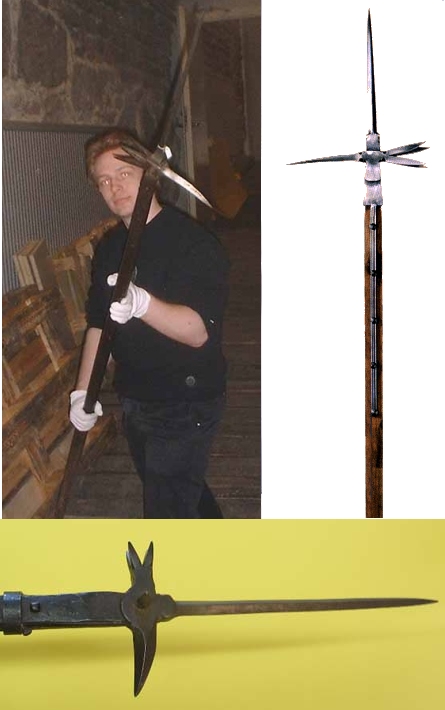
- Dead Hammers - The Watchers (a
combat Necromantic Brotherhood, see
our House Rules for the new
Necromancer magic and profession)
award these Lucern Hammers or
Bec-de-Corbins (see 7Hex
Dragon House rules on PoleHammers) to their most courageous and
active Warders (or those on particularly dangerous missions). These
PoleHammers radiate negative energy, creating a very faint wavy aura
around the Hammer. It sucks life energy and heat, to the touch the
head and languets feel like a combination of cold and very mild
shock. It can put out torches and small camp-type fires if thrust in
them and held for several turns. Hits drain ST against normal living
beings. Demons and the non-normal-zombie/non-skeleton undead suffer
"burns" and react as if strong light had been presented to them when
at close range (Kirean Zombies, Wights, Spectres, Vampires, all
demons, etc) and are at -1DX (-2DX for ShadowWights) in combat with
the wielder. The Watchers have had a long alliance with the Dwarves
of the Backbone Mountains after the Watchers helped rid a demon
invasion out of the lower levels of their caverns. The Watchers
provide many services (resident Physikers, resurrections,
demon/undead banishment, and aid during crises or attack) to the
Dwarves in exchange for weapons and armour (and occasional military
and fortification help). This allows most Warders to posses Fine
Weapons or Armour at a fairly early stage if they do a stint with
the Dwarves. Additionally they collaborate on enchanted weapons
with specifically Necromatic effects. The Dead Hammers are one such
prized project. They are made of Fine Silver (+1DX, +1Damage) and
have the ability to drain 1d6 of life per hit (registers as fatigue)
on any attack that penetrates armour (this 1d against the undead or
demons is burn damage and not fatigue and it is 1+2 against Shadow
Wights). In either case the extra damage is not included in
any charge attack damage multiplier and only assessed after damage
has penetrated armour. Animals and Undead will shy away from it all
things being equal (i.e. trained dogs, pack animals, warhorses will
put up with it after some initial shyness and
angered/summoned/trained animals will ignore it). It does full
damage against Banshees, Spectres, Ghosts, Wights and Night-Gaunts
(though will only do the 1d burn damage if
insubstantial). Additionally, the first successful attack by a Dead
Hammer causes an Induce Fear against non-demon/undead victims who
must save vs. IQ or suffer the effects of that spell. They are
engraved down the languets with Necromantic Runes and with a silver
skull as the butt cap for some balance and a blunt attack
option. They are effectively unbreakable (except maybe under some
catastrophic extreme: thrown in a Dwarven furnace at full
temperature, etc) and when given to a Warder is attuned to him so
that it is hard to drop (i.e. gets a 3d save or Contest Save vs. ST
against the spell or against a critical miss). Rumour has it that
there one each Bec-de-Corbin and Lucern Hammer that house their own
Spirit Fields and could be used to cast spells or summon undead (in
fact: ST 9 IQ 12: Summon Spectre, 3Hex Darkness, Detect Undead,
Banish on successful damage-causing hit at normal ST cost). This too
can cause a slight negative reaction roll as there will be a subtle
sense that something is not right that the interlocutor can't quite
put his finger on...
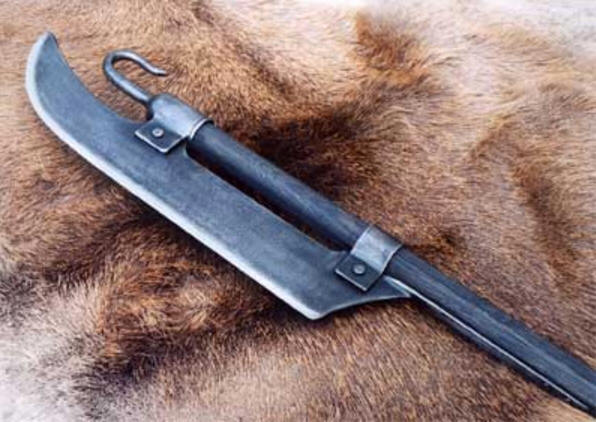
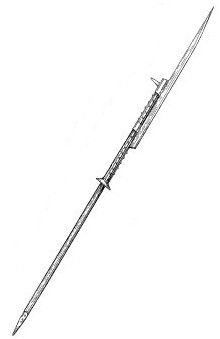
- Demon Cleaver -
Lochaber type ax devised by
the Battle Priests and shamans
of the eastern High Plains to combat
the demonic presence coming out of the
Wildwood in the century after the
Calamity. The use of the ax in general for heavy infantry came
from the Kirean Elite heavy infantry troops who survived the
Calamity in Kir Ornalt and
who mixed with the barbarians of the High
Plains and created what they called the cleaver (treat as a
halberd for damage). It is a long, thin bladed lochaber-type axe,
connected at two points to a pole of varying length with a back-hook
for dismounting cavalry. These Cleavers are made of Fine Silver
(+2Damage, +1DX) and do an extra 1d of damage against demons. They
also make it harder for Demons to hit the bearer as it shines in the
presence of demons (and only demons see this glare). -2DX for demons
to hit the wielder. One or two were reported to house a Spirit Field
and posess a rudimentary intelligence (though no
language). Speculation is that many more housed a Field or even some
kind of Spirit. Most were lost as they were mainly produced to
combat a demonic invasion 850 years ago. The TaHote Tribe marched
out against odds and were killed to a man. Their last stand (as
observed by some women hiding in the nearby woods) is still sung how
they made a last stand circle around a small hill and as they were
killed they stepped back to shrink and close the circle. The line
held until the last dozen were overwhelmed. They were mostly
destroyed by the horde then, but a few other were made prior to that
battle and those have been passed around and lost over the
years. The Horde, somewhat weakened over time, was driven back two
centuries later by the an alliance
of High Plains Tribes (on a vision
quest by a tribal chief's son) and they then seemed to retreat back
into the Wildlands of their own accord.
- Dragon Scale Klanth -
Dragonnewt Klanth (Bastard Sword) made of obsidian with a thin edge
of Dragon Scales. They all do +2 damage and will tingle if held in
the presence of those who mean Dragons or Dragonnewts
harm. Depending on the kind of dragon scales are used they will have
additional properties:
Black - Induce Fear (on first damage), Darkness (normal ST cost)
Green - Poison (must break skin, 2d unless save), Lock (normal ST cost)
Red - Flame Blade, Light (normal ST cost)
White - Frost Blade, Freeze (on first damage) (normal ST cost)
Silver - Lightning (on contact damage, normal ST cost max 2ST), Dazzle (normal ST cost)
Gold - Control Animal/Control Person (on damage), Knock (normal ST cost)
They are designed by the Dragonnewts and other races are at -2DX to
use them. Some have Dragonic Spirit Fields that can give some advice
on simple choices (Dragons are good at prophecy) or give ST battery
to the wielder and a spell or two.
- Dragon Fang Necklace - Necklace
with the Fang of an ancient dragon on it. Gives the wearer 2 points
armour and the Dragon Breath Spell
(see 7HexDragon House Rules
at normal ST cost). Must be touching skin. Will decay over a one
year period of heavy use (wear it most days whether adventuring or
not), or 3 years of highly selective use (only on adventures when
combat is near). Wearer gets +1 reaction with dragonnewts and
dragons, and -1 reaction with Dwarves.
- Dragon Staff - Staff of Power
that:
1) if you know the proper Summoning Spell can Summon a
small dragon for 2+1 ST cost and a Dragon for 3+1
2) Dragons
will be mildly favourably inclined to the holder +1 reaction roll,
while dwarves will be at -1
3) Staff shoots Dragon Breath doing
2d to all in 1Hex wide line, 4 hexes long (great for narrow tunnels)
for 2ST Cost.
Carved out of a reddish mahagony with a brass
dragon head and scaly woodwork. Ends in a brass ball and claw and
weighs 4Kg. The Staff, if kept close for several weeks, will start a
very slow transformation of the character. The character will
become very possessive of the Staff (GM should manipulate
this and report a large number of theft attempts against it that are
not in fact real, but he does not tell the possessing character this
and will only tell other characters they may be false if they
actively investigate the matter over a period of time). His life
will be greatly extended. He will start, over a period of years, to
slowly grow scales, fangs and clawed hands. After the 5 year mark,
he will have 1 hit natural armour and at 10 years he will have 2 hit
natural armour. His head will start to transform into a small
human/dragon mix and he will get the breath weapon of a half-damage
small dragon at half ST cost. Life expectancy is 200-400 years if
the Staff is kept within 1 hex of the character for 15 hours or more
per day (which should not be difficult since the character will be
increasingly possessive of it). A few were made several centuries
ago by mages of Mt. Bronar with the help of the Dragons that live
near there. Two are still held by the Duke and Mages of Mt. Bronar.
Ice Dragon Staff: variation on the main Dragon staff except it is
made of white wood with the dragon head on top made of an ice
crystal that steams gently in warm weather. Instead of fire, it
shoots a Cone of Cold as per the spell in
7Hex Dragon House
Rules.
Green Dragon Staff: black wood staff with Jade dragon head and
claw/ball. Cloud of poison gas 1x4 hexes in place of fire (instant
1d, armor doesn't help, then ST 11 poison that will cause 1-6 turns
paralysis, watch which way the wind blows!).
Silver Dragon Staff - slim silver staff with small sliver dragon
head. Ads +2 per die of the lighting spell you cast through it. When
used as a melee weapon, ST10 contest save to avoid -2DX for 2 turns
due to electric shock muscle control issues.
- Elk Tine Longword - Long, elegant
thin katana-type gently curved swords with long (15 inch) hilts made
of Elk Antler (treat as a Bastard Sword). Gift from the smiths
of ka'Han to a
High Battle Priest of a large
Western Barbarian Tribe and her
commanders in appreciation to a daring raid to rescue a large cohort
of ka'Hanese merchants from a large hymenopteran hive sweeping in
from the south west. They are fine silver (+1DMG +2DX) and for 1ST
can cast the Speed Movement Spell on the wielder. It is carved with
pictures of the Tree of Life on the sides of the blade and for 2ST
can cast a Fortify spell which gives all friends within your MH +1ST
and +1DX as they feel the life force flow through them to new
purpose for 5 turns, additionally giving them +1 on Contest Saves
against morale-type spells/situations (fear, gloomy, etc). This is a
high honor to carry one of these elegant, well-crafted and powerful
blades in a barbarian culture that is a bit technologically
retrograde with their crude
lochabar axes,
Jeddart Staves and
boar spears.
- Elven Bows and Arrows - Horse and
Long Bows made of special woods and elven craftmanship. Designed to
work well with balanced Elven Arrows, the combination gives the user
up to +2 Damage and +2DX. They are not likely to be given out
to other races (except Centaurs) and most Elves will have a hostile
reaction if it sees a non-Elf/non-Centaur with an Elven Bow, unless
the individual is of such vast fame as that most elves around the
world would know this person as an Elf Friend. Minimum ST is one
more than that required for a normal Horse or Long bow. Some few
bows have Spirit Fields on the Bows and can cast spells (Silent
Movement, Rope, Detect Life, Reverse Missiles).
- Fox Cape - Rich, elaborate, brocaded
and fur lined cape, used for formal dress events by
the Order of the Fox in their
diplomatic functions. It combines the Persuasiveness, Detect Lie and
Detect Enemies spell into one Diplomat's Boon that for 2ST you can
walk around persuasive and knowing the liars and enemies around you
for 12 turns. These capes are not allowed at
the Thurian
or IS courts.
- Frost Wand - Clear, icy and thin
crystalline wand, about 20 inches long and exquisitely embossed with
complex patterns that catch the light and refact it in beautiful
patterns. It steams lightly in warm weather. Any frost spell cast
through it (Frost Cloud, Cone of Cold, Create Frost Elemental) will
do one more hit of damage (per die for Cone of Cold/Icicle Spray or
just generally if a Frost Cloud). Also removes one point of damage
from fire (either per die for fireball/dragon breath or just one
point for the fire spell) if held in the ready hand facing the fire
attack. For 1ST can cause light patterns that can befuddle any who
are looking at it. Saving throw vs IQ to avoid it (victim does not
have to take a turn to do this). Befuddled will stop moving and
stare for up to 3 turns at the light show. Any sudden event will
break the befuddlement (loud noise, sudden movement, being attacked,
etc). If you own all three of the Crystal
Cape, Ice Crown and Frost Wand, you get
extra powers. See the Crystal Cape for
details. Dragons and fire elementals may not like you so much.
- Frost Star - Forged on the icy
plains of the Karlyd
Tundra, this Spiked Mace glimmers and the head gives of a slight
steam in temperatures above freezing. The head appears to be made of
ice, though it doen't melt in any normal circumstance. It does an
extra +3 cold damage if the mace penetrates armour. For example, a
man in chain mail and tower shield is hit for 5 points as rolled for
a normal, non-magical Morning Star. Since the Star did not penetrate
the armour no damage is done. If the Star had done 6 points of
damage, with one point going through to the man, then it would be 4
points total damage (1 point normal damage, 3 points frost). If the
mace does a total of 5 points or more, the target suffers a -2DX for
three turns of frost shock/shivering. The Frost Star does 1.5xDamage
(2x weapong damage if using 7Hex
Dragon's House Rules against fire creatures (elementals and the
like) and dragons. Fire damage is halved if you are in a fire
hex. Dragon breath and focused fire attacks (fireball, etc) are at
-1 per die damage against the wielder. The Star will melt if dumped
in a hot furnace (hot enough to temper metal) for an hour or more,
though when the Star hits the furnace, there is likely to be all
kinds of explosions and bursting steam which may break the furnace
or eject the Star. The Star will put out a torch in one turn and a
small campfire in 3 turns.
- Gleremere Mirage Staff -
Wizard's Staff about 4 feet tall made of clear glass topped by a
multifacted, multicolored glass globe. It has to have the Staff of
Power spell cast on it by the wizard who uses it to atune it to
him. The Staff:
1. Casts dazzle spell at no ST Cost (though you have to spend the turn casting it)
2. If you turn it and look through the right color, you get the same effect as the Iris Glass Jewels
3. If you look through the clear portion of the globe, you have Mage Sight at no ST cost (but see 5 below).
4. Any illusion cast by the wielder actually has some residual reality such that if the illusion is disbelieved it will stay around as a shadowy version of the creature at 1/3 ST and damage, but you must double the cost of the Illusion spell when cast.
5. Staff can be made to light up like a torch for 1ST per day (like the Light spell) (but you can't use the Mage Sight/Control Person and Light functions as the same time).
6. Note! This staff does not hit for any damage whatsoever (too
fragile). Just carry a dagger.
- Gleremere Glass Swords -
The glass smiths in Gleremere devised broad and bastard swords that
were light, sharp and highly durable. They are +2 DX for their
lightness but -1Damage (-2 Damage for the lightness, +1 for
sharpness). However they have different properties depending on the
glass:
Black Glass - drain st, does an extra 1d6 damage in
fatigue if the sword pierces armour and can cast Darkness at normal
ST cost.
Blue Glass - mariner's blade - allows user to swim and
breath under water and call a magic rain storm as if he knew the
spell +2Damage to fire creatures.
Red Glass - can throw 1 or 2
die fireball (with appropriate ST cost) per turn and can "flame"
blade at 1ST per 5 turns. +1 Damage to water and ice creatures.
Clear Glass - allows the user to cast the Dazzle spell (just like
the holder knew the spell) and glows as bright as a torch at will
(no ST cost).
Frosted Glass - does +1 frost damage and first
successful hit and victim suffers -2DX due to the intense
cold. Glows dimly in the dark. +2 damage against fire creatures.
- Golden Fans (Last Airbender) -
These fans do +2 damage (or +1 protection if unfolded into a
buckler). Additionally for 1ST they can fly around for 5 turns
attacking opponnets in the Mega-MX, but the
Kyoshi must concentrate on it while it
is attacking.
- Graknon Knife - The Graknon Knife
was the flower of Graknon
civilization. The Graknon were an advanced orc tribe that
settled down and made an uneasy and surprising alliance with the
dwarves of the Backbone Mountains. The Chief Warlord ordered a small
number (50) of these enchanted Orc Swords to be made for his
personal Guard. These Enchanted 2 handed Orc Swords do 3d
Damage. Additionally each successful attack causing damage requires
the victim to Contest Save the ST of the wielder vs. ST of the
victim or the victim will be knocked down and back one hex (this
only applies to 1 and 2 hex creatures, Giants and Dragons are
unaffected by this property of the Knife). The name was a little
joke trying to downplay the force of the weapon ("Got yer knives on
ya? We're goin' ta dinner!"). Great in formation for crowd clearing
or trying to break through an enemy formation.
- Grey Cloaks - Cloaks of
the Grey Line (a.k.a. Grey
Knights) for their elite. They add 1 point to armour for no DX
loss, they muffle sound for increased surprise chances (GM
discretion) and can, for 1 ST be cast as a thrown spell to blind and
entangle a foe, or function as a whip for that same turn. Contest
save DX of thrower vs DX of victim for entanglement (treat as the
rope spell, but they have to recover the cloak to re-cast it). The
Grey Knights have demonstrations where they wield a long dagger and
then the cloak in their off-hand, using the cloak as defense, whip
and blinder. Always a crowd favorite.
- Grellmore Axes - Dwarven War
Axes. A handful of weapons created by the Dwarves of the Backbone
Mountains from the unknown metal extracted from a meteor shower 700
years ago. Difficult to work with, dense, hard, but not brittle, of
a slate grey in colour with shimmers of silver, it took half a
(Dwarf) generation to make the tools and furnaces that could break
free and work with the substance. The first things made were tools
to further extract this ore. After several smithing tools were
made, a small run of Dwarven War Axes, Armour and Shields were
produced at the behest of King Grellmore for the elite group of
warriors who ran risky missions in the deepest caves/mines and
against strong foes. The rest was used to line the inner gates of
Grellmore Hall. The Axes are backed by an effective fluke/spike and
topped with a thin triangular spike for punching through armour.
All of these Axes require 2 higher ST to use due to their density
and are -1DX to use (though they are partially balanced at the
butt-end). They inflict an extra +3 damage and ignore 2 and 4 points
of armour for the one and two hand versions, respectively. On 3 or
4 to hit, the Axes will shatter the non-magical, non-fine shield or
armour of victim (or weapon if they happen to parry that turn) and
the Axes will ignore armour (having cut through it). They are
unbreakable outside the specially designed furnaces the dwarves
constructed just for this purpose and possibly the most active of
volcanoes, though none have ever tried to melt any artifact in that
manner. Any item made from this ore is highly prized and
guarded. Any theft of such and item will be pursued relentlessly and
with vigour by the entire elite squad who possess the Axes, Armour
and Shields along with their squires, paid spies and allies. Note,
these items of themselves are not magical, but can be (and almost
always are) enchanted.
- Imperial Crystal Ball -
Specially designed by the Secret Police of the Imperial Sorcerers to spy on a particular
group or place, they are very specific and can only be used to see
other things by adding 1 die to the rolls given in Advanced
Wizard. If you use it for it's intended purpose (i.e. to spy on the
individual, place or miliary group), you get to subtract 2 from your
roll against IQ. It will still not penetrate a conceal, pentagram,
spell shield, etc. The attunement takes 10ST and 3 days (with a 3d
roll against IQ to see if it worked) if you have something of the
person (hair, blood) or place (grass, soil). It takes 25ST and 2
weeks if you do not and you must make a 4 die roll every week
against IQ to make it work.
- Ice Crown - Belonging to the Frost
Dragon Herders (a tribe in the small boundry between the Glaciers
and the Karlyd Tundra), this crown:
makes the wearer immune to
cold
Contains a 10ST Frost Elemental that can be called out and
controlled for 1ST/turn
. The crown is a frosty ice and the
Elemental can be seen swirling around inside. Gives the wearer a +2
Reaction Roll with Frost Dragons
and can cast a Mist spell for
no ST at will (one per turn)
-1 (or per die) from Fire Damage. If
the Elemental is killed, you will have to cast the Create Elemental
spell (max 10ST) to replace it. If you can collect
the Crystal Cape, Ice
Crown and Frost Wand you get extra
powers. See the Crystal Cape for details.
- Ice Flail - Common weapon of the
Karlydian Ox riders. The
flail cauases +1 frost damage and the victim must save vs. ST to
avoid 3 turns of -2DX due to chills and stiffness. When whirled
about and for 1ST, will cast a 3 Hex Frost Cloud (See
the 7 Hex Dragon House
Rules for a description of the 3 hex frost cloud spell). A
charging formation of Karlydian
Oxen will often be preceded by a giant dense wall of frost
cloud...
- Imperial Infantry Staff
- This staff is issued to Wizards of the Imperial Sorcerers that are
attached to field units. They are very long, 6-7 feet long. They are
designed to help Wizards be effective in the field.
1) By
doubling the cost of any Thrown spell, the staff will act as a
magnifier and allow the Thrown spell to use Missile Weapon range DX
modifiers. So if you add 2ST to cast the Stone Flesh spell on
another person, you can use missile weapons DX modifiers (so no
penalty for 1 - 2 MH distance, -1DX for 3-4 MH distance, etc). There
is no extra ST cost to maintain the spell.
2) It hits for 2d
damage even though it is not a Staff of Power.
This staff is
often used to cast MH Freeze spells on charging enemies (causing
following units to fall or break formation) then the light infantry
or even cavalry can use the confusion to break through enemy
lines). And since they have distance they can often get their spells
in first. This also helps with Spell support from behind the
lines. They are generally attuned to members of the Imperial
Sorcerers Corps.
- Iris Glass Jewels - there once
was a race of wizards who lived on the beaches north of Dar Miralo
and the Wildlands, in the city-state of Gleremere. Those beaches
were subject to lightning storms and they became master
glassblowers. The mages specialised in mind control. They created
glass jewels/lenses that if matched the colour of the victim's eye
would cast Control Person (or Animal) at no ST if:
1) The caster
held the lense over one eye
2) The caster is able to gain eye
contact (even if just briefly)
3) Keeps the victim in sight at
all times with the lense over one eye. Save vs. IQ (3 die or Contest
Save, see 7Hex Dragon House
Rules ). Costs 1ST per turn to utillize.
If the victim is lost to sight (due to darkness, or other obstacle
or great distance), the spell is broken. Clearly the caster can't
fight or do much else while using the lense. Note eye colour in
characters or roll to see what it is. Dwarves tend to the
brown-hazel-grey spectrum. Elves the green-blue-purple
spectrum. Humans/hobbits brown to green to blue. Orcs are
black-red-gold. Dragons and undead are immune. Animals tend to be
brown-red. Unless the user has a wide collection (the wizards of
gleremer used to cary a range embedded in specially designed leather
strips that allowed them to look through several to get the right
one), roll for generic eye colour of a target until you get
something that fits:
black 3-4
green 4-6
brown 7-10
hazel 11-14
blue 14-15
red 16-17
purple 18
- Iron Shock Scepter - This is
basically a short solid-iron Wizard's staff/wand, 20 inches long
with the scepter's flanged head inlaid with silver lighting bolts on
either side of each of the 4 flanges. When you pick up this Scepter,
you take 2 hits shock damage. The next turn the Scepter is painful
to hold, but causes no damage. After that you suffer no negative
consequences while you continue to hold it. Shock Shield is on all
the time starting the third turn you hold it with no ST cost to keep
it in effect. Unfortunately any creature you touch (with your hand,
bump into, etc) will suffer 2 hits damage from electricity the first
turn you touch them (and then the full shock shield damage after
that if they continuously touch the holder). If you know the
lighting spell and cast it through the Scepter, it will add +2 per
die damage. If you hit someone with the Scepter, it will do 1+2
damage and can be used in HTH combat as a dagger (plus the attacker
will suffer 2 hits the first turn in HTH in addition to the Shock
Shield, then full Shock Shield after that). If you put the Scepter
down for more than one turn, you will have to pick it up again and
suffer the 2 hits damage. Requirements: Minimum ST is 14 to hold the
Scepter and endure the electrical current. Down side, roll 3d for
any month you held the Scepter for more than one continuous hour. If
you roll an 18, you will suffer a minor stroke and lose 1 each ST,
IQ, DX permanently. The Scepter will eat itself up providing all
this power and will fall apart in 2 years of moderately active use.
- Kalcrear's Skull - Kalcrear became a great Lich over 300 years
ago and "lived" over 200 years in what is now the IS city of Thur
and later in life, Dar Miralo. He was able to bend so much Spirit
Energy around him, his relics have themselves been imbued with a
form of Spirit Field. This allows for a more potent Spirit Jar (8ST)
or NecroStaff (12ST). The NecroStaff made with the Skull can Summon
a Lich for only 1ST initial cost (the 2ST per turn is still
required). Additionally, you may cast one Induce Fear per turn for
no ST cost. You must know (not cast from a book) the Spirit Jar
spell and cast it on the Skull to get the benefits. The skull will
eventually decay, but most of the power comes from the Field, which
is potent, and will last 4-500 years..
- Kalcrear's Spine - This adds
2ST to any NecroStaff made with it. It is Kalcrear's Spine held together with a silver
rod, molded to the bones. You must know (not cast from a book) the
NecroStaff spell and cast it on the Spine (and any skull, though see
below if you have Kalcrear's Skull too!) to get the benefits. The
spine will eventually decay, but most of the power comes from the
Field not the spine, so I give this effectively infinite life (400
years).
- Kalcrear's NecroStaff If
you combine Kalcrear's Skull and the Spine
in one NecroStaff you get the Lich powers of Mage Sight with no ST
cost and a MH Induce Fear centred around your hex at no ST cost at
will (though it takes one turn to turn the MH Induce Fear on, and
remember it works on your friends too). The NecroStaff holds a total
of 18ST as a battery. It also keeps individual attributes of the
Skull and Spine.
Requirements:
1) Know the NecroStaff spell
to put the Skull and Spine together into your own NecroStaff.
2)
Know the Summon Lich Spell (memorised)
- Karlydian Cloak - These cloaks
are produced in the Karlydian Tundra and are
very advanced stealth cloaks made of white fur that give the user
the the ability to blend into snowy landscapes and have anti-scrying
properties such that crystal balls and other easvesdropping will
have to make a 4-die Contest Save against the average of IQ and ST
of the wearer. In anything approaching a snowy terrain, the cloak
provides a +2 to surprise opponents not on the look out for you (not
invisibility, just really tough to see).
- Kirean Stone Dagger - These
terrifying intruments were used as part of the ritual to
create Kirean Zombies, a
unique brand of zombie that involved the torture and ``sacrifice''
of victims. The intense torture created
an Impressioned Remain
that was bound back to the corpse, giving it limited intelligence
and memories of the victim. This dagger is at -1DX in combat as it
is heavy and unbalanced. However its evil magic makes it dangerous,
does 1+2 damage (no ST bonus in HTH) and any successful hit causes
wracking pain that puts the victim at -3DX for 3 turns and will have
to save (Contest or against ST) to avoid an Induce Fear effect. If
the dagger is the only weapon that damages the victim and causes
it's death, the the victim has to make a 5 die saving roll against
their IQ to avoid an Impressioned Remain being created from their
Spirit being torn from their body. The binding of the Impressioned
Remain was a separate spell that was lost with the sudden
destruction of the Kirean Kingdom. These
daggers do decay over many uses (4-500 years with "regular"
use). Hopefully
that spell died with the Kirean Kingdom. They originally came from a
banshee infested quarry near the base of Mt. Kir (where hundreds
died in a village near the base of the volcano). The anguished
banshee Spirit Energy seems to have infected the very rock that the
daggers are made out of.
- Merchant's Credit Stick - From the
cult of the Traveler/Trade Deity of the
High Plains Barbarians is this ordinary
looking credit stick (notches would be cut into the stick, then
split in half so each side to a deal would know how much credit was
advanced). It is a traveling merchant's friend. It will cast the
Reveal Value spell for 1ST. You can touch one item per turn for 5
turns. You can also cast the Detect Lies spell for the normal cost
of the spell as if you were a wizard. If you are a wizard and know
the Detect Lies spell, well, sucks to be you. Once you split it, all
the above listed powers are lost, but a new one is gained. If any
party to the original credit agreement touches either half of the
stick, it will glow dimly as will all the original notches (so any
added surreptitiously later will not glow), and if the stick was cut
to hide legitimate notches, the cut end will glow a pulsing blood
red.
- Night Crystal - This smoky
quartz crystal is in the shape of a clawed human hand (though
slightly smaller than an average human hand), in the shape of a
closing claw. First, if a
Night-Gaunt/Wight/Ghost/Spectre/Banshee/Vampire comes within 5MH of
the holder, it will flicker dimly and the holder will become aware
of the general location (the MH) that the creature is in. Secondly,
it has special powers over Night-Gaunts. If a Night-Gaunt is
insubstantial, the Crystal can freeze it or force it's movements,
one hex per turn, up to 5MH distance from the Crystal (you can
stroll along with them at a slow pace). If a Gaunt tries to become
substantial within 5HM of the holder, he must also make a 3d save
against ST to attempt to become substantial if the holder of the
Crystal does not want it to become substantial. Once substantial,
the holder can cast a ``control person'' type spell at the Gaunt
(with the same cost as the spell). The Gaunt gets a 4d save
vs. ST. Only one Gaunt at a time can be controlled in each state
(i.e. you can force the movement of one insubstantial while
controlling one substantial Gaunt). The crystal has to be ``ready''
in a hand or attached to a (Necro)Staff. The user cannot attack
while controlling a substantial Gaunt and can only attack if he is
"freezing" an insubstantial Night-Gaunt (not making it move). ST
cost is 2ST to cast the Control Gaunt spell and 1ST per turn to
continue control. Controlling an insubstantial Gaunt has no
cost. Though once you stop forcing it to move it is likey to want to
attack you.
- Obsidian Hammer - From the
Obsidian Underground group of Earthbenders (see
House rules for Avatar: the Last
Airbender). They are Fine (+1Dmg, +1DX) Hardened Obsidian Hammers
(Pick, War, Great or Pole) that have the Open Crevace spell ability
if you strike the ground with them (user must pay normal ST cost
minus 1).
- Orcish Shaman Staff - The
Orcish Shaman Staff is made from any odd collection of bones of at
least 5 hostile enemies that the shaman has personally killed. When
assembled and the Staff of Power spell cast on it, it does:
1. 2d damage like a Staff of Power
2. Can Cast a Berserker spell (T) at 1 ST cost
(see our House Rules).
3. Cast 3-Hex Darkness at 1ST
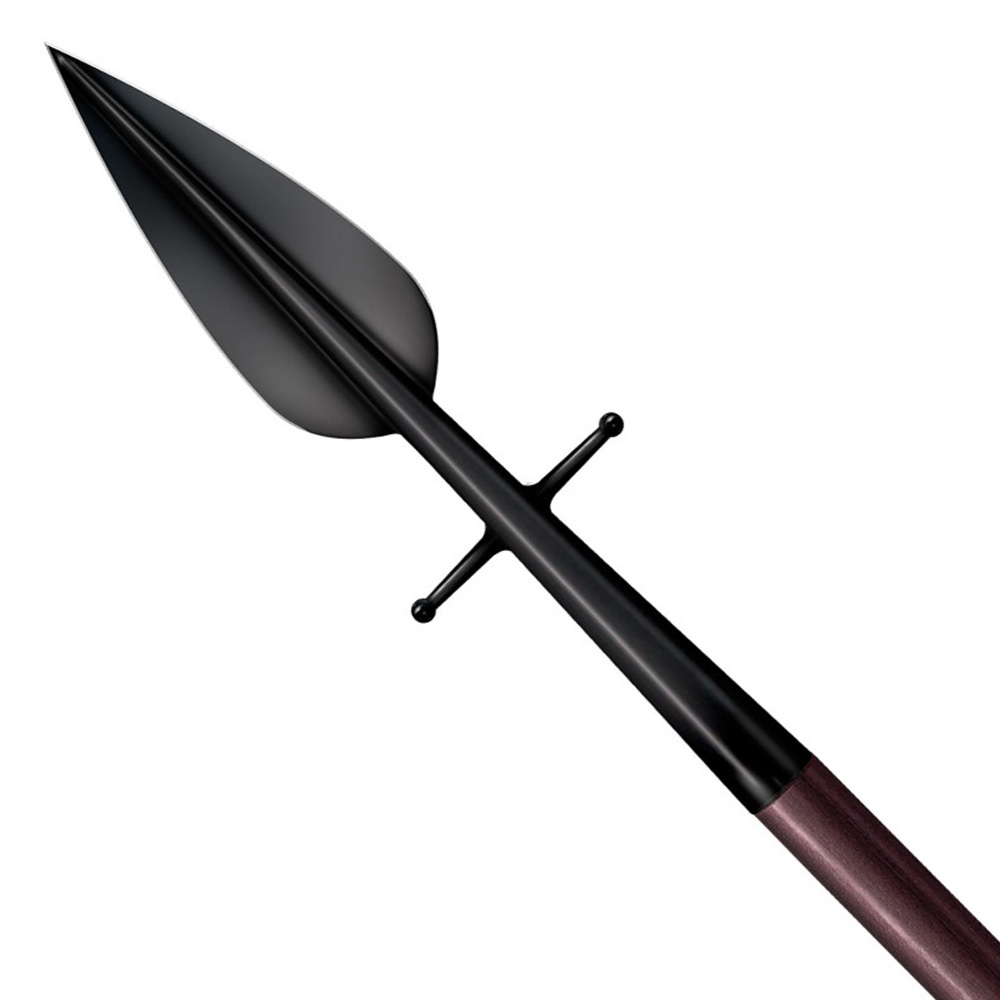
4. Can summon Orcish Spirit to inhabit the Staff or an Enchanted Orc
Sword. Spirit has IQ 8 and ST 9 and can cast Darkness, Slow Movement
and Induce Fear (and can be used as a battery). Cost 3ST, spirit
stays for 12 turns.
- Peace Sapling - temporary staff
made from a young sapling in the springtime. Wielded by a trained
priest(ess) of the Love Cult of the High
Plains Barbarians it can create a calming and morale boosting MH
aura centered on the wielder. This will create a +1 for all reaction
rolls, a willingness to trust and negotiate in good faith with
others in the MH. Used for courtship and marriage counseling and
other dispute resolutions. Staff functions (and blooms) until the
Summer Solstice. As you might imagine, marriages, divorces and
trade/land/personal disputes are all resolved in the Spring where at
all possible. Where resources allow, special saplings are planted
early so that they are ready on the first day of Spring. Costs 10ST
to create it and 1ST per day to maintain it alive and active during
the Spring.
- Ranger Cloak - Cloak developed by
the Ranger Elves of the Wildwood in
conjunction with the Centaur Rangers. It comes in two forms,
humanoid and Centaur. If it fits, it will immediately render the
wearer very hard to see in any natural surrounding (forest, natural
cave, plains, etc). Secondly it will damper noise and odour coming
from the characters movement. This adds chance to surprise as the GM
sees fit. I basically gave them a 5 out of 6 if the characters were
trying to surprise and 3 out of 6 if they were just generally being
careful and not being directly watched. Once they are in combat they
are of course completely visible, though I give archers a chance not
to be seen after their first turn if they are in any kind of cover,
giving them a second turn of surprise. At a cost of 1ST per turn the
wearer can increase his MA by 50 percent round down to nearest even
number. Will degrade if subject to combat and must be repaired
periodically or lose its power (I usually wing this one, but say
every 40 points damage the character takes while wearing it breaks
it). Repairs should be expensive and hard to find!
- Raven's Mask - The
Order of the Raven is a
Knightly Order in
Thur that upon Knighting
(called the Burning) award the new Knight an Iron Mask with a crown
and grotesque face (can be gargoyle-esque, a raven, a skull or other
ghastly form). Most newly awarded Masks are mundane, but many
wealthlier Ravens have had theirs enchanted. Many are buried in
them, but others are handed down to squires or eldest male heirs.
The basic enchanted Mask will cast an Induce Fear spell like the
Necromancer Spell at same strength cost. It also gives an additional
1 point to your armour total. These masks seem to have a permanent
soot and charing about them that slowly alters of it's own accord as
it is used, making the Mask more hideous than it already is. It
seems to adapt to it's surrounds too becoming darker at night,
etc. They are made of thin iron, carved in great detail, but made
almost as strong as adamant. Rumour of the orginal Raven's Mask (in
the shape of a raven skull) say it had MH Induce Fear and could turn
into an undead raven familiar with it's own MH Induce Fear spell.
- Scorpian Staff - A Staff with the
Scorpion Staff spell
permanently on it. Generally causes fear in Giant Spiders, and Giant
Scorpions are not likely to attack the holder unless summoned, being
attacked by the wielder or under direct control. Hymenopteran will
have +1 reaction roll. Has the 2Hex Jab capability of the
spell. Takes one turn to "turn on" at cost of 1 ST and stays on for
5 turns. After the spell is cast, the weilder must decide to hit
with the staff like any other weapon or take some other action. The
staff does not have a mind of it's own.
- Silver Lighting Sword -
Also from the forges of Gleremere, the Silver Lighting Sword came
from the same lightning struck beaches that produced Gleremere glass
objects. The Sword can redirect lighting such that if the wielder is
attacked with lighting, he may redirect it to someone else upon
successful contest save DX of the lighting caster vs. DX of the
wielder. Additionally it can cast up to a 2D lighting bolt, wielder
pays normal ST cost. Glows dimly in very dark settings, not enough
to see by. Comes in Broad and Bastard versions.
- Silver Wolf Cloak -
The The Order of the Wolf
has a small number of these ancient silver wolf skin cloaks that
allows the wearer to double their MA, and be silent at a cost 1ST
per turn. In anything approaching a forest setting, the wearer is
difficult to see or hear, at no strength cost increasing chance to
surprise. This is not invisibility and anyone on the look out will
see the wearer, GM discretion. Wolves will show a fearful respect to
the wearer unless directly controlled/trained.
- Sonic Fourche de Guerre (Last Airbender) - A
Military/Tuning Fork that:
- Standard Halberd type pole arm in melee.
- +2 damage to all sonic attacks (See Avatar: The Last Airbender House Rules)
- Increases Sonar sensitivity to an extra MH and +1 on any contest saves to see invisible, etc.
- Soul Mirror - The Soul Mirrors were
created by the same Gleremere mages who
created Iris Glass Jewels
and Gleremere Glass Swords . These
mirrors were used to trap the souls of the unwary. The victim would
live in a shadow world while his body would be occupied by
another. The duration of trapping is limited (24 hours). If the
victim is unwilling, then they get a 3D save against IQ to avoid
forced capture (or a Contest
Save. The victim must look into the mirror at the eyes of the
captor for the effect to take place. Cost: 10ST to use and minimum
IQ of 12. It was considered poor taste to have a large mirror in
rooms or places where people gathered in Gleremere. Made by a rogue
Gleremere Necromatic Brotherhood that was put down by the
Necromancer Enforcers Brotherhoods.
- Spirit Vortex - singular ancient
artifact from before the days of the Necromancer Brotherhoods, when
shamanism, necromancy and magic were in their infancy. It is the
petrified shards of what can only be imagined as powerful tree of
life and death (maybe the same kind of tree as the Weeping Willow Shaft?),
a spirit sinkhole and trap. Likely haunted by powerful spirits, both
malicious and virtuous. When thrown and 5ST spent to activate it, it
create a spirit vortex which is a MH induce fear and a Mega-MH
despair and decrepify for 5 turns. All must (contest) save vs ST to
avoid the multiple effects. Those at the epicenter will have all
three effects hit them. The visual is just a dim, flickering,
spinning vortex of barely visible shadow pulling at all in the area
of effect down towards the center of the vortex. The intense,
vertigo inducing feel is more pronounced and ominous. You feel the
life and spirit being sucked out of you. All strength, joy,
rationality, vitality, anger all drain away, you feel weak, heart
fluttering and pausing, headache, until you feel you will be left a
shambling shell with nothing human left of you. A wandering
death. The undead will be hypnotized and walk towards the center
with no thought of self-protection if they don't contest save IQ of
caster vs IQ of victim.
- Talisman of the Boar - small boar
charm carved out of a wild boar tusk. Gives the recipient of its
touch +1 ST and +4 MA and 1 hit armour for 5 turns at a cost of 2ST
to the caster, can be used on self. Used by a few shaman of
the High Plains
- Thurian Horseman's
Hammer/Pick - (2+1 ST13), If using the damage table
from 7HexDragon's House rules
then the Horseman's Hammer does 1+2 over Unarmed damage and has a
-1DX penalty like other hammers, and has a 13 ST requirement. The
elite horsemen of Thur use a special kind of long handled, one
handed millitary hammer/pick designed to be used from horseback
(though it can certainly be used unmounted). It is longer and a
little heavier than a normal pick (hence the extra point damage and
higher ST requirement), has a three pronged hammer head, backed by a
fluted spike and topped with a short thick spike. It ignores 1 hit
of armour (not including shields). If owned by a Thurian noble,
they are enchanted to be immune from Break Weapon and Drop Weapons
spells and each
Thurian Order has it's own spell in
their Hammer (at normal ST costs to cast it):
Order of the Bear
- Drop Weapon
Order of the Wolf - Speed Movement
Order of
the Llama - Detect Lie
Order of the Fox - Detect Enemies
Order of the Hawk - Far Vision
Order of the Bat - 4Hex
Shadow
Order of the Raven - Induce Fear
Order of the Boar -
Avert
Order of the Chameleon - Invisibility (very rare)
- Undine's Aquamarine - 10
carat Aquamarine that has been put into a bracelet by the Dwarves of
Backbone Mountain. It allows the wearer to cast Control Elemental at
an Undine at no ST cost (and no need to memorize the spell), allows
user to swim and breath under water, even if in full armour. Allows
user to cast Magic Rainstorm at 2ST cost if they have sufficient IQ
for the normal spell (though again, the wearer does not need to
actually memorize the spell). The origins of this are lost. Some
Sea-faring Elves claim it is theirs to help their voyages. Some
Dwarves claim it is theirs used to get past a huge underground lake
they discovered (in fact it was the sea elves stationed near Gleremer who brought it over, but
the dwarves stole it).
- Vampire Lord's Fang - The fang
of a Vampire Lord/Prince when worn touching the skin gives the
wearer the equivalent of the Charisma talent with Wights, NightGaunts, Shadow Wights and Vampire
Spawn. and Mage Sight and Invisibility at normal ST cost. Of
course, only works if you are living! You stop showing up in mirrors
and Necromancers and Vampires will look at you funny. Will decay
over 1 year of heavy use (wear it most days) or 2 years of selective
use (only when adventuring in dangerous areas).
- Warder's Fine Brigandine
- Another collaborative work with the Dwarves of the
Backbone Mountains and the Necromancers. Warder's Brigandine consists of very thin
admantine or mithril plates rivited between two specially treated
layers of leather formed into a long coat, split at the waist front
and back to allow horse riding and easier movement. They are light
but very effective in stopping damage. Unenchanted, it has a -3 DX
but stops 5 hits. Then additional enchantments can be given to
increase hits stopped and other protective or offensive properties
(often things like blur, shock shield, etc). They are black and have
Necromantic symbols inlaid into the leather that give +2 damage
protection against demons and undead attacking by hand (i.e. vampire
bite, Night-Gaunt in HTH, Spectre's touch, etc). On the other hand
if, for example, a Night-Gaunt is using a weapon, it will not add
any undead defense bonus.
- Wailing Willow Shaft - 5 foot
staff made from the rumored Spectral Wailing Willow Tree. Ancient
tales tell of the ominous Black Willow from the great swamp that was
a portal to the other side. Pilgrims would come from long distances
to talk to departed loved ones, shaman would come to enhance their
powers. The rapacious, demented and demonic would come to build
undead armies. It was feared it served as a hanging tree outside of
collective memory as the highly atuned to the spirit field can
sometimes hear a muted wailing
in the night, with fears of multiple deeply buried and maybe trapped
banshees. Its powers were always held with high
suspicion, even more than most Necromantic objects. The tree has
long ago been lost, but several of the staves that were carved from
it by unknown Necromantic magic and used for powerful NecroStaves
(see 7HexDragon House
rules). Any NecroStaff made with a Wailing Willow shaft (which
replaces the non-skull bone) gains the following powers: +2 to the
ST battery, successful touch casts both the Drain Life and Induce
Fear spells on the living for 1 ST cost (no need to know the spell) or
Repel Undead on an undead victim (just for that one undead creature,
no need to know the spell) for no ST cost, grants wielder a
combination the Communicate with the Undead spell coupled with
Persuasivness for 1ST (and you don't have to know the spells, only
works on the undead, one at a time).
- Weeping Wand - Evil work of unknown
origin, probably renegade Necromancers, Lich, Vampire
Coven or super-powerful Shadow
Wight Mages. These wands are made from a recently dead Weeping
Willow and the death cry of a sentient being. Used as a weapon it
hits for a Drain Life on
contact (as opposed to 1d a normal staff will do), going straight to
heal any fatigue of the wielder. Optionally and additionally in
combat, a Despair spell can be cast on those touched with the wand,
Cost 1ST. When blown on it sends out a piercing baleful cry that
acts like a MH Induce Fear spell centered on the wielder and a
Despair spell to any in a 3MH radius. All
must Contest Save IQ vs. IQ
of the caster. Costs 3 ST to get the Piercing Cry
(see the Banshee). There is rumor
of a super-weeping wand (the "Banshee Staff") made from a rare
charcoal grey wood weeping willow of vague sentient malevolence in
the Great Swamp. Not only did the evil creator of this wand kill the
tree and capture the death wail of a woman killed in an unspeakable
way, but also induced and captured the banshee that emerged from her
terrible death. In addition to all the powers of a normal Weeping
Wand, the Despair spell on contact costs no ST. It can cast the
Induce Fear, Despair or Decrepify spells as a thrown spell at normal
ST cost minus 1. It also houses an actual banshee that can be
summoned out of the wand and controlled to spy, wail and do other
dastardly things. It takes 2ST to summon her, but no ongoing ST to
control her. She will go back into the wand after 12 turns and must
be re-summoned. For 1 ST you can cast a MH darkness centered on the
Wand. The wood of the wand acts as a 5pt strength battery also. This
wand has a weak Spirit Field of its own and will interfere with a
Spirit Jar or NecroStaff (See 7HexDragon's House Rules
for the Necromantic Arts and the Spirit Field). Note this wand is
only about 18 inches long and can be used in HTH combat. Animals
will be nervous and shy around it, want to avoid getting near unless
well trained (war horse, guard dog) or summoned. Certain sensitive
individuals (people and animals) will also feel anxious around it.
|